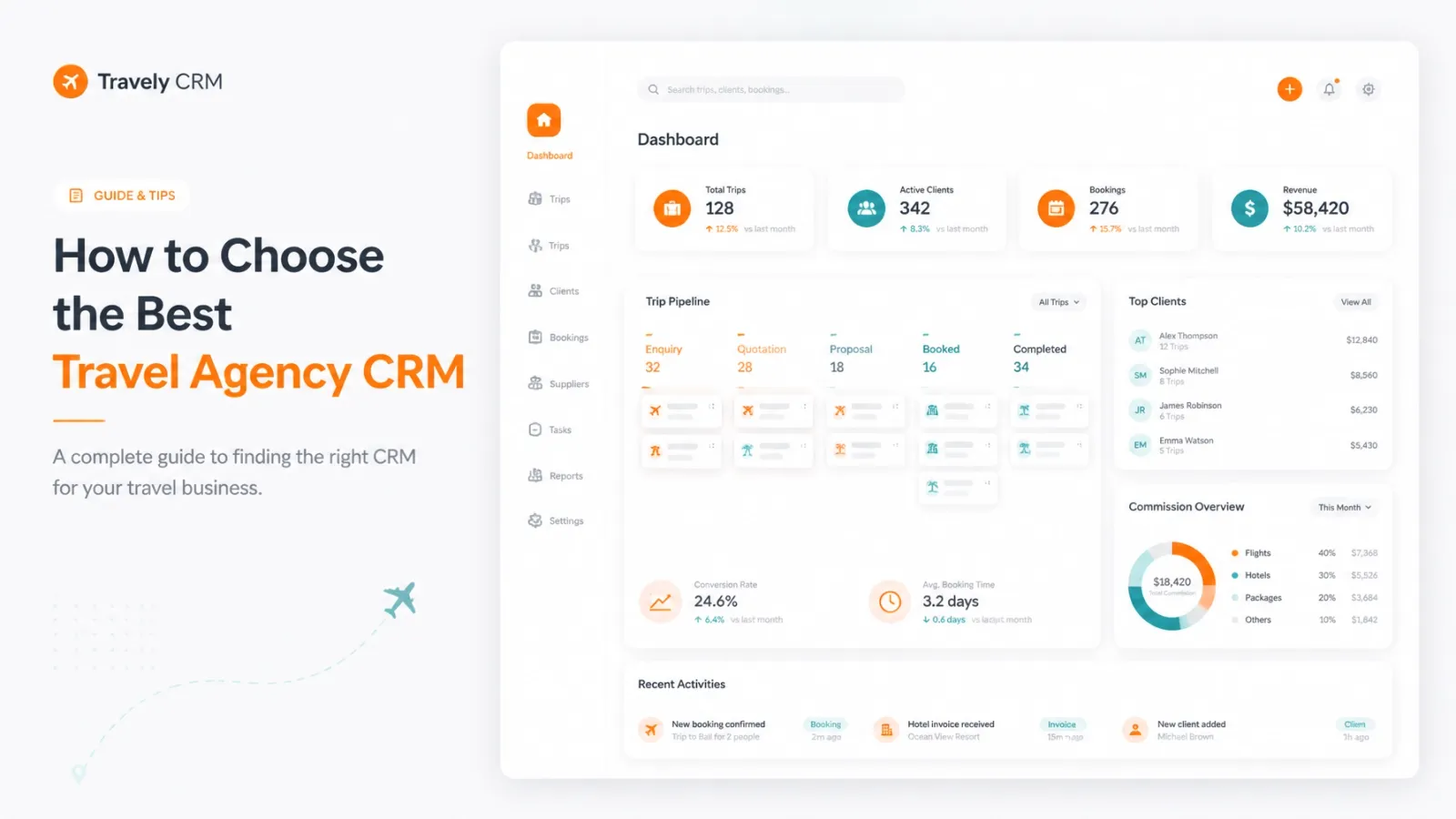
How to Choose the Best Travel Agency CRM (Compared for 2026)
You’re likely here because your agency is running on a "duct-tape" stack.
One tab for your itinerary builder. Another for a generic CRM like HubSpot or Salesforce that costs $100 per seat. A third for a spreadsheet that tracks commissions because the CRM doesn't understand "split percentages." And a fourth just to keep track of the sticky notes on your desk.
None of them talk to each other. All of them charge per seat.
It’s a multi-tab marathon that kills your profit margins and melts your brain by 3:00 PM. In 2026, the gap between "getting by" and "scaling fast" is the system you choose. You don't just need a place to store phone numbers; you need an operating system.
Here is how to cut through the noise and choose a CRM that actually carries the load.
The "Frankenstein" System: Why Generic CRMs Fail
Most agencies start with a generic CRM. It seems logical. But travel isn't a standard sales cycle. You aren't just selling a widget once; you’re managing a complex, multi-stage lifecycle involving suppliers, varying commission structures, and changing flight schedules.
Generic tools are built for "Leads" and "Deals." They aren't built for "Trips."
When you try to force a travel workflow into a generic CRM, you end up with a Frankenstein system. You spend more time "stitching" tools together with Zapier than actually selling travel. If your CRM doesn't natively understand what a "Supplier" or a "Commission Split" is, you’re building on a weak foundation.
The 4 Non-Negotiables for 2026
If you’re auditing a new platform, don't look at the marketing fluff. Look at the mechanics. A modern travel CRM must handle these four things without breaking a sweat:
1. Trip-Centric Pipelines: Most CRMs focus on the person. A travel CRM must focus on the *trip*. One client might have three different trips in three different stages. If you can't see that at a glance, you'll lose the details.
2. Commission Reconciliation: This is where most agencies leak money. You need a system that tracks what you’re owed versus what you’ve been paid.
3. Automated Follow-ups: 80% of travel sales are in the follow-up. If your system doesn't nudge you to check in 14 days before departure and 2 days after return, it’s just a digital filing cabinet.
4. Supplier Management: You need a central library of your DMCs, hotels, and tour operators. If that info lives in one person's head, you have "tribal knowledge" risk.

Example of a dedicated commissions module that handles the heavy lifting of financial reconciliation.
The 2026 Comparison: Who’s Who?
The market has shifted. We’ve moved away from "all-in-one" tools that do everything poorly, toward platforms that actually understand the builder's perspective.
Travefy: The Itinerary Specialist
Travefy is the industry heavyweight for a reason. Their itinerary builder is beautiful. If your main friction point is "making my proposals look professional," Travefy wins.
* The Pro: The best consumer-facing documents in the game.
* The Con: The CRM side can feel light for larger agencies that need deep operational reporting.
Tern: The Modern Contender
Tern is the "new kid" that grew up fast. It’s built specifically for the modern advisor. It treats trips as opportunities and has a very clean, intuitive UI.
* The Pro: Very "travel-native" logic. Great for independent advisors.
* The Con: Still expanding its automation capabilities. You’re still doing some of the manual stitching yourself.
ClientBase: The Old Guard
If you are a high-volume agency tied to a GDS (Global Distribution System), ClientBase is the legacy choice. It’s powerful, deep, and established.
* The Pro: Incredible GDS integration and back-office depth.
* The Con: It feels like software from 2005. The learning curve is steep, and it doesn't "play nice" with modern mobile-first workflows.
AgencyOS by Beacon Labs: The Operational Foundation
At Beacon Labs, we saw agencies struggling with "tool fatigue." AgencyOS isn't just a CRM; it’s an operating system. We built it to replace the 6+ tools you’re currently paying for.
Instead of an itinerary builder plus a CRM plus a commission tracker, it’s one platform built around how your team actually operates. We focus on systemization until the manual steps are gone. We ship working software in weeks, not quarters.

The "Build vs. Buy" Dilemma
Sometimes, the "off-the-shelf" solutions just don't fit.
Maybe you have a unique host agency model. Maybe you have a specific way you handle group bookings that no CRM supports. This is where the "Sort-of Fit" becomes a liability.
If you spend 20 hours a month working *around* your software, it’s time to consider a custom studio build. We specialize in building platforms for businesses that have outgrown spreadsheets. We don't just give you a login; we build the scaffolding your business needs to scale.
Audit Your Inefficiency: A Self-Test
Before you sign a new contract, ask yourself these three questions:
* The "Seat Tax" Check: Am I paying per user for features only 10% of my team uses?
* The "Manual Marathon" Check: How many times am I copy-pasting data from an email into my CRM today? (If it's more than five, your system is failing).
* The "Tribal Knowledge" Check: If my top agent quit today, would I know exactly which suppliers they were talking to and what commissions are pending?
If the answer to that last one is "No," you don't have a business; you have a collection of talented people working in a burning building.
The Bottom Line
Choosing a CRM in 2026 isn't about the prettiest UI. It’s about the "load-bearing" capacity of the system. It should hold your data, automate your follow-ups, and track your money so you don't have to.
If you’re tired of "duct-taped" workflows, let’s talk. We offer a GAP assessment to find exactly where your revenue is leaking before you commit to a single line of code.
Stop managing spreadsheets. Start running an operating system.